

The Sannas – a Couple, a Northern Outpost and an Extraordinary Restaurant
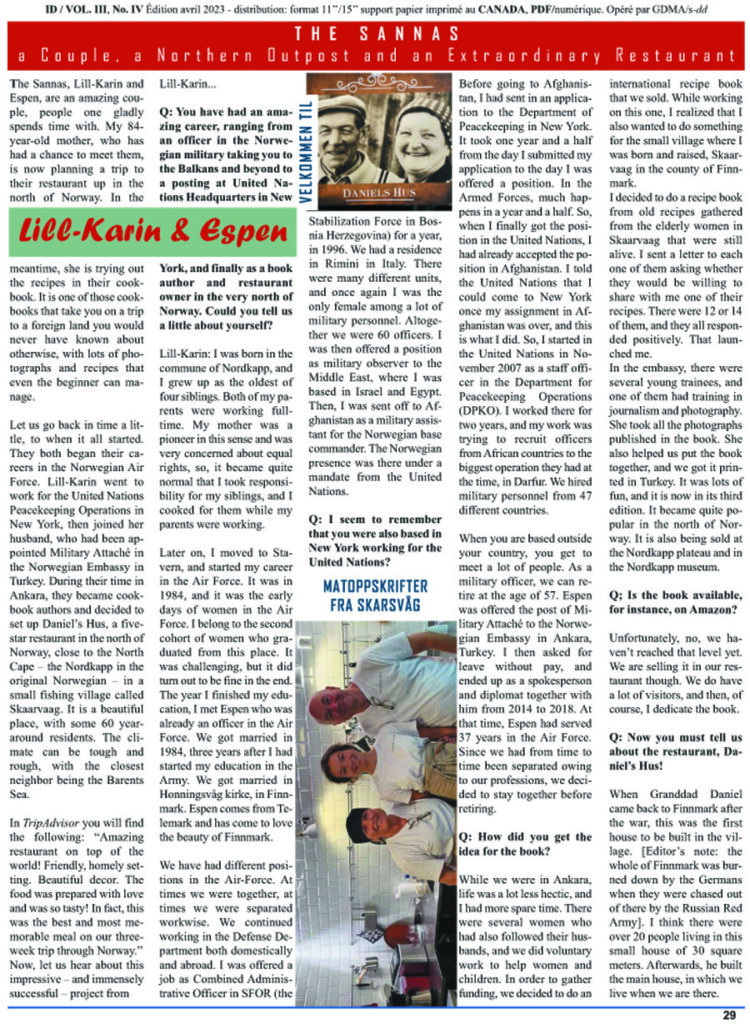
The Sannas, Lill-Karin and Espen, are an amazing couple, people one gladly spends time with. My 84-year-old mother, who has had a chance to meet them, is now planning a trip to their restaurant up in the north of Norway. In the meantime, she is trying out the recipes in their cookbook. It is one of those cookbooks that take you on a trip to a foreign land you would never have known about otherwise, with lots of photographs and recipes that even the beginner can manage.
Let us go back in time a little, to when it all started. They both began their careers in the Norwegian Air Force. Lill-Karin went to work for the United Nations Peacekeeping Operations in New York, then joined her husband, who had been appointed Military Attaché in the Norwegian Embassy in Turkey. During their time in Ankara, they became cookbook authors and decided to set up Daniel’s Hus, a five-star restaurant in the north of Norway, close to the North Cape – the Nordkapp in the original Norwegi
an – in a small fishing village called Skaarvaag. It is a beautiful place, with some 60 year-around residents. The climate can be tough and rough, with the closest neighbor being the Barents Sea.
In TripAdvisor you will find the following: “Amazing restaurant on top of the world! Friendly, homely setting. Beautiful decor. The food was prepared with love and was so tasty! In fact, this was the best and most memorable meal on our three-week trip through Norway.”
Now, let us hear about this impressive – and immensely successful – project from Lill-Karin…
Q: You have had an amazing career, ranging from an officer in the Norwegian military taking you to the Balkans and beyond to a posting at United Nations Headquarters in New York, and finally as a book author and restaurant owner in the very north of Norway. Could you tell us a little about yourself?
Lill-Karin: I was born in the commune of Nordkapp, and I grew up as the oldest of four siblings. Both of my parents were working full-time. My mother was a pioneer in this sense and was very concerned about equal rights, so, it became quite normal that I took responsibility for my siblings, and I cooked for them while my parents were working.
Later on, I moved to Stavern, and started my career in the Air Force. It was in 1984, and it was the early days of women in the Air Force. I belong to the second cohort of women who graduated from this place. It was challenging, but it did turn out to be fine in the end. The year I finished my education, I met Espen who was already an officer in the Air Force. We got married in 1984, three years after I had started my education in the Army. We got married in Honningsvåg kirke, in Finnmark. Espen comes from Telemark and has come to love the beauty of Finnmark.
We have had different positions in the Air-Force. At times we were together, at times we were separated workwise. We continued working in the Defense Department both domestically and abroad. I was offered a job as Combined Administrative Officer in SFOR (the Stabilization Force in Bosnia Herzegovina) for a year, in 1996. We had a residence in Rimini in Italy. There were many different units, and once again I was the only female among a lot of military personnel. Altogether we were 60 officers. I was then offered a position as military observer to the Middle East, where I was based in Israel and Egypt. Then, I was sent off to Afghanistan as a military assistant for the Norwegian base commander. The Norwegian presence was there under a mandate from the United Nations.
Q: I seem to remember that you were also based in New York working for the United Nations?
Before going to Afghanistan, I had sent in an application to the Department of Peacekeeping in New York. It took one year and a half from the day I submitted my application to the day I was offered a position. In the Armed Forces, much happens in a year and a half. So, when I finally got the position in the United Nations, I had already accepted the position in Afghanistan. I told the United Nations that I could come to New York once my assignment in Afghanistan was over, and this is what I did. So, I started in the United Nations in November 2007 as a staff officer in the Department for Peacekeeping Operations (DPKO). I worked there for two years, and my work was trying to recruit officers from African countries to the biggest operation they had at the time, in Darfur. We hired military personnel from 47 different countries.
When you are based outside your country, you get to meet a lot of people. As a military officer, we can retire at the age of 57. Espen was offered the post of Military Attaché to the Norwegian Embassy in Ankara, Turkey. I then asked for leave without pay, and ended up as a spokesperson and diplomat together with him from 2014 to 2018. At that time, Espen had served 37 years in the Air Force. Since we had from time to time been separated owing to our professions, we decided to stay together before retiring.
Q: How did you get the idea for the book?
While we were in Ankara, life was a lot less hectic, and I had more spare time. There were several women who had also followed their husbands, and we did voluntary work to help women and children. In order to gather funding, we decided to do an international recipe book that we sold. While working on this one, I realized that I also wanted to do something for the small village where I was born and raised, Skaarvaag in the county of Finnmark.
I decided to do a recipe book from old recipes gathered from the elderly women in Skaarvaag that were still alive. I sent a letter to each one of them asking whether they would be willing to share with me one of their recipes. There were 12 or 14 of them, and they all responded positively. That launched me.
In the embassy, there were several young trainees, and one of them had training in journalism and photography. She took all the photographs published in the book. She also helped us put the book together, and we got it printed in Turkey. It was lots of fun, and it is now in its third edition. It became quite popular in the north of Norway. It is also being sold at the Nordkapp plateau and in the Nordkapp museum.
Q; Is the book available, for instance, on Amazon?
Unfortunately, no, we haven’t reached that level yet. We are selling it in our restaurant though. We do have a lot of visitors, and then, of course, I dedicate the book.
Q: Now you must tell us about the restaurant, Daniel’s Hus!
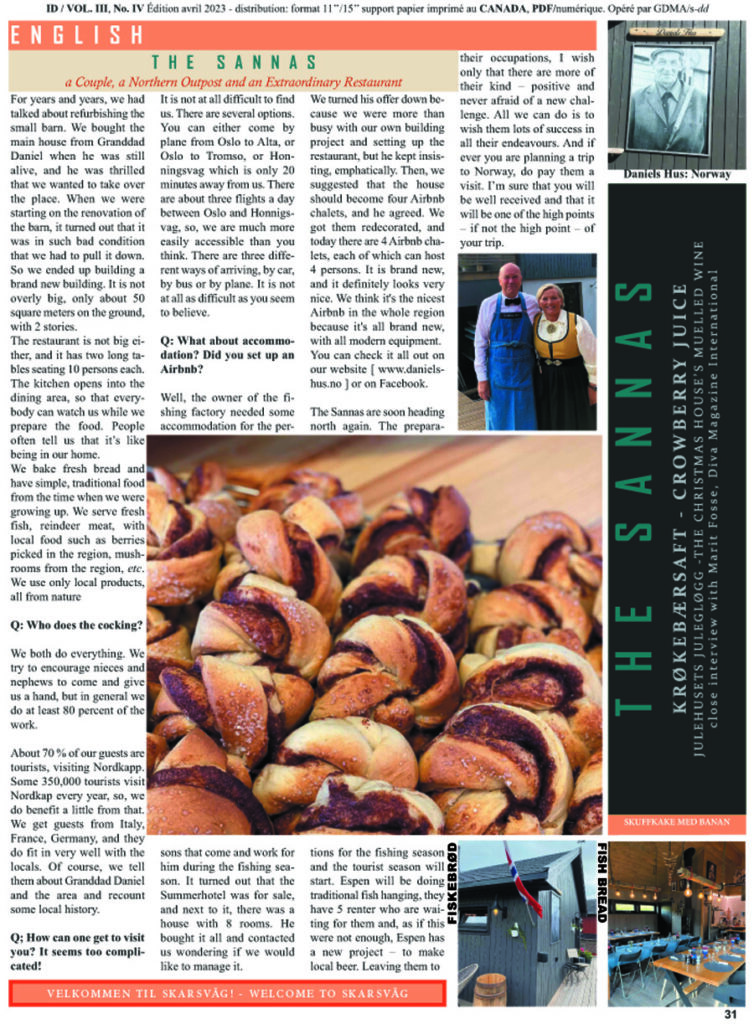
When Granddad Daniel came back to Finnmark after the war, this was the first house to be built in the village. [Editor’s note: the whole of Finnmark was burned down by the Germans when they were chased out of there by the Russian Red Army]. I think there were over 20 people living in this small house of 30 square meters. Afterwards, he built the main house, in which we live when we are there. For years and years, we had talked about refurbishing the small barn. We bought the main house from Granddad Daniel when he was still alive, and he was thrilled that we wanted to take over the place. When we were starting on the renovation of the barn, it turned out that it was in such bad condition that we had to pull it down. So we ended up building a brand new building. It is not overly big, only about 50 square meters on the ground, with 2 stories.
The restaurant is not big either, and it has two long tables seating 10 persons each. The kitchen opens into the dining area, so that everybody can watch us while we prepare the food. People often tell us that it’s like being in our home.
We bake fresh bread and have simple, traditional food from the time when we were growing up. We serve fresh fish, reindeer meat, with local food such as berries picked in the region, mushrooms from the region, etc. We use only local products, all from nature.
Q: Who does the cocking?
We both do everything. We try to encourage nieces and nephews to come and give us a hand, but in general we do at least 80 percent of the work.
About 70 % of our guests are tourists, visiting Nordkapp. Some 350,000 tourists visit Nordkap every year, so, we do benefit a little from that. We get guests from Italy, France, Germany, and they do fit in very well with the locals. Of course, we tell them about Granddad Daniel and the area and recount some local history.
Q; How can one get to visit you? It seems too complicated!
It is not at all difficult to find us. There are several options. You can either come by plane from Oslo to Alta, or Oslo to Tromso, or Honningsvag which is only 20 minutes away from us. There are about three flights a day between Oslo and Honnigsvag, so, we are much more easily accessible than you think. There are three different ways of arriving, by car, by bus or by plane. It is not at all as difficult as you seem to believe.
Q: What about accommodation? Did you set up an Airbnb?
Well, the owner of the fishing factory needed some accommodation for the persons that come and work for him during the fishing season. It turned out that the Summerhotel was for sale, and next to it, there was a house with 8 rooms. He bought it all and contacted us wondering if we would like to manage it.
We turned his offer down because we were more than busy with our own building project and setting up the restaurant, but he kept insisting, emphatically. Then, we suggested that the house should become four Airbnb chalets, and he agreed. We got them redecorated, and today there are 4 Airbnb chalets, each of which can host 4 persons. It is brand new, and it definitely looks very nice. We think it’s the nicest Airbnb in the whole region because it’s all brand new, with all modern equipment.
You can check it all out on our website [ www.danielshus.no ] or on Facebook.
The Sannas are soon heading north again. The preparations for the fishing season and the tourist season will start. Espen will be doing traditional fish hanging, they have 5 renter who are waiting for them and, as if this were not enough, Espen has a new project – to make local beer. Leaving them to their occupations, I wish only that there are more of their kind – positive and never afraid of a new challenge. All we can do is to wish them lots of success in all their endeavours. And if ever you are planning a trip to Norway, do pay them a visit. I’m sure that you will be well received and that it will be one of the high points – if not the high point – of your trip.
ID Canada / ISSN 2563-818X (En ligne) – ISSN 2563-8181 (Imprimé)